2026-11-03
Content
Walk a hotel corridor at eleven at night and you can hear the building working: luggage wheels, a door easing shut, the low hum of the air handling. Walls in that corridor take everything a busy property throws at them, and they are still expected to look considered a decade later. That is the brief the Hospitality Collection PVC wallpaper was built against. Our team has spent more than ten years in coating and manufacturing, and since 2019 we have been supplying decorative materials into hotel projects, so this collection is less a mood board and more a set of answers to problems we have watched hoteliers and contractors run into on site.
Residential wallpaper is designed for a room that is decorated once and lived in gently. A guest room is a different proposition: a new occupant every night, housekeeping with a trolley twice a day, curtains pulled hard, suitcases resting against the wall while someone finds their key card. Multiply that by years of operation and you get a material brief that has very little to do with pattern trends.
What hospitality wallcovering actually has to deliver comes down to a handful of things. It has to survive routine cleaning without losing its surface or its colour. It has to hold a seam on a wall that may not be perfectly flat. It has to arrive in a consistent shade across rolls produced in different batches, because a corridor is viewed as one continuous surface and any drift between lots shows up immediately. And it has to look intentional, because guests read the corridor as evidence of how the rest of the property is run.
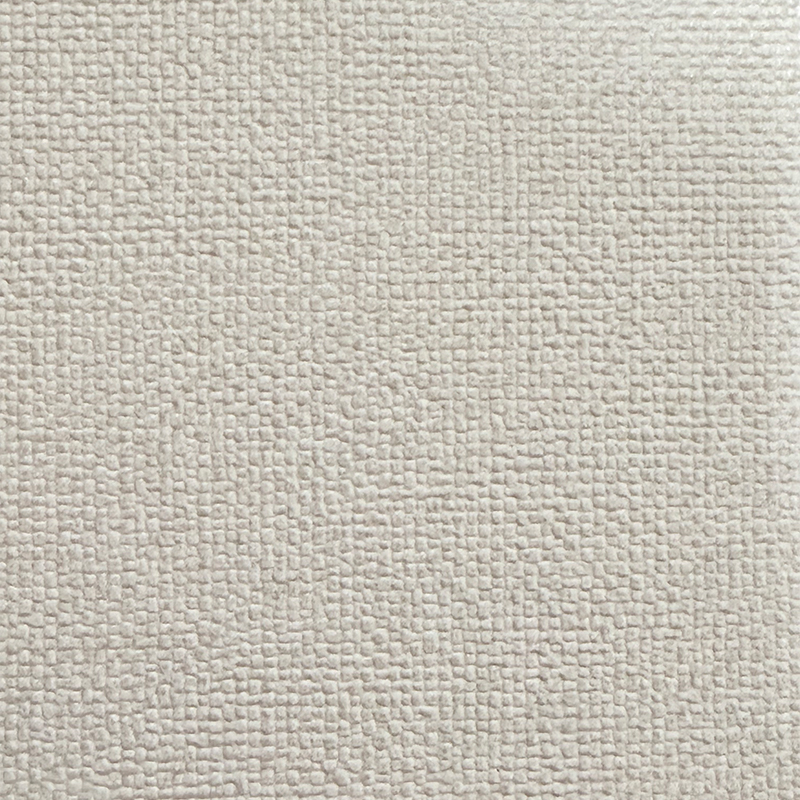
The collection is organised around construction rather than decoration. Three decisions do most of the work.
Non-woven backed PVC wallcovering is the calm, forgiving option. The non-woven base is dimensionally stable, it does not swell when paste goes on, and it hangs cleanly on walls that have been patched and repainted over the years. Cross-woven fabric backed PVC wallcovering puts a woven textile base under the vinyl skin, which brings noticeably more tensile strength and a stiffer hand. Where a corridor takes trolley traffic and the wall runs long and uninterrupted, that extra body matters.
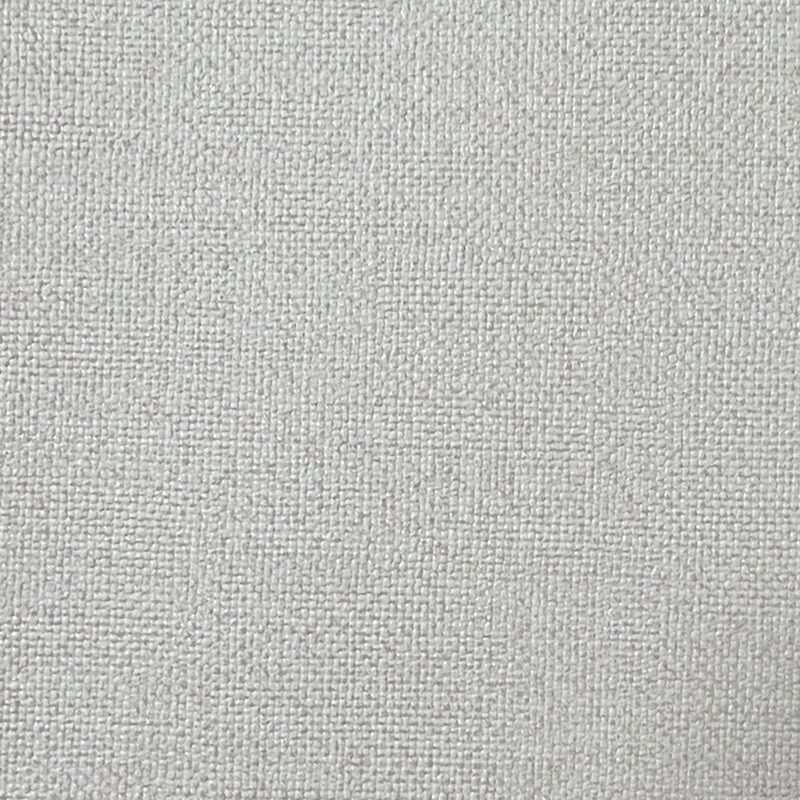
High gram weight, deep embossed constructions give a wall physical texture: linen weaves, plaster effects, subtle stipples that catch light from the side. They also hide substrate imperfection better than a flat surface, which reduces the amount of skim coating a contractor has to budget for. The trade-off is honest: deeper relief holds dust slightly more readily, so it belongs on walls that housekeeping already wipes, not on those that are only dusted at turnaround.
We work with two routes. Build-Up Printing layers ink to create a relief effect, which suits patterns that should feel embossed rather than printed. Plant-dye inkjet printing produces softer, more natural tonal transitions, which suits the muted, tactile palette that hotel interiors tend to settle on. Both routes are calibrated for batch-to-batch consistency, because a shade that drifts from one roll to the next is the single most common complaint a project team brings back after installation.
The table below is the shortcut version of conversations we have most often with designers and contractors. It is a starting point, not a substitute for looking at the actual wall.
| Construction | Typical hotel use | What it gives you |
|---|---|---|
| Non-woven backed PVC | Guest rooms, suites, quiet residential corridors | Stable hanging, clean seams, forgiving on older substrates |
| Cross-woven fabric backed PVC | Main corridors, lift lobbies, high-traffic circulation | High tensile strength, dimensional stability, resistance to scuffing |
| High gram weight, deep emboss | Feature walls, restaurants, lobby accents | Deeper texture, better concealment of wall defects, softer visual weight |
| Build-Up Printing | Signature patterns, branded zones | Raised relief effect without a separate embossing pass |
| Plant-dye inkjet | Guest rooms, spa, quiet public areas | Natural tonal depth and a gentler, less graphic finish |
Non-woven backed PVC keeps its shape through seasonal humidity swings, and because it does not expand with paste, a refurbishment team can strip and rehang between departures without re-plastering. Softer plant-dye inkjet colourways tend to sit well here; guests spend time close to these walls, and heavy pattern rarely ages as gracefully as texture.
This is where cross-woven fabric backing pays for itself. Long runs demand consistent shade and strong seams, and trolley traffic punishes anything thin. If the corridor is a fire route with a lot of door surrounds and returns, discuss the sequence with the installer early, because pattern matching across many short drops is where waste creeps up.
Deep embossed constructions are happiest here, where the wall is meant to be touched and seen in raking light. Keep a specification file for each feature area; if the wall is repainted or partially replaced later, matching a deep relief from memory is far harder than matching a flat print.
Most hospitality installs happen in a building that is either partially occupied or racing a soft-opening date. Two practical habits save a great deal of friction. First, hang a full-height sample wall in a real room before the main order is released; it costs a day and it surfaces problems with lighting and substrate that no printed swatch will show. Second, keep the maintenance stock in the same room temperature as the installation area, so that the spare rolls behave like the installed ones when they are eventually needed.
Day to day, PVC wallcovering wants very little: a soft cloth, a mild neutral cleaner, and a light hand. Abrasive pads and solvent-heavy products will dull the surface long before the wall itself fails, and in a corridor that dulling is visible from twenty metres away.
The Hospitality Collection comes out of our own production in Zhejiang, where we work as an original manufacturer rather than a trading house. Our background is in coating technology, we were recognised as a national high-tech enterprise, and our scope covers research, production, sales and installation of hotel decorative materials. Alongside PVC wallcovering we produce wall panels, contract curtains and accessories, and PVC composite sheet flooring, which means a project can come to one team for the hard finishes and the soft ones together instead of stitching four suppliers into a single corridor.
We entered hotel decorative work in 2019 and set ourselves up in 2020 as a supplier for combined hard and soft furnishing packages. That history is useful mostly because it taught us where projects actually go wrong: batch matching, delivery timing, and the small gap between what a render shows and what a wall can do.
If you are working through a hotel refurbishment, send us the wall build-up, the traffic pattern and the lighting conditions. We will tell you honestly which construction in the collection suits that wall, and which one you should probably avoid.
Recommended Products
Recommended News





 English
 русский
 Español
 عربى